Documenting Progress and Reflections in the Garden
My attempt to document the planting, growth, harvesting, and preserving of our family’s 8000 square feet of garden.
Northeast Iowa Gardening in growing zone 4
Last frost date May15, First frost date September 15
April, Week 4
In week 4, two sunny, windy days at 80 degrees dried the soil, making it ideal for planting and cleanup.
Tasks I worked on:
Removed the protective covers from the blueberry bushes. We cover them in the wintertime to prevent rabbits and dear from nibling them down. Here are the covers we use: https://amzn.to/3ONB9BR . I also sprinkled ¼ cup of sulfur chips around each bush to help lower the Ph of our soil.Our soil, on average, is around 7-9 on the Ph scale and blueberries need the soil to be between 4 & 6.While a soil Ph of 7-9 is great for corn and beans it is not so great for blueberries. But before you rush out and purchase a Ph test kit there a couple of ways to know your soil Ph without purchasing anything.
If you live where pine trees grow naturally, reseed themselves, and thrive, then you very likely can grow blueberries without any special effort. Because pines and blueberries love the same soil Ph. In our area, any pines that you see have been cultivated by man.
If your blueberry bushes consistently have yellow leaves instead of green, even after fertilizing, it may indicate that your soil is too alkaline. Alkaline soil can block blueberries from absorbing essential nutrients from both the soil and any fertilizers you apply. Clay soil is another reason your blueberries might appear yellow after fertilization. Because blueberries have extremely delicate, hair-like roots, they thrive in light, airy soils such as peat. Even in Iowa, where clay soil isn’t common, we still add bags of peat to our blueberry beds to ensure healthy growth.
I cleared some more of the garden, raking off last season’s sweet potato vines making room for planting more cold crops.
What I Planted
10 gm. spinach (Bloomsdale)
10 gm. lettuce blend *for cut lettuce
3.5 gm. red beets (Detroit Dark Red)
3.5 gm carrots (Tender Sweet)
5 lbs. Russet Potatoes *for fresh eating
5 lbs. Yukon Gold potatoes *for fresh eating
1-pound yellow onion sets
50 sweet onions (Purple Candy)
50 sweet onions (Walla Walla)
Seedlings I Planted
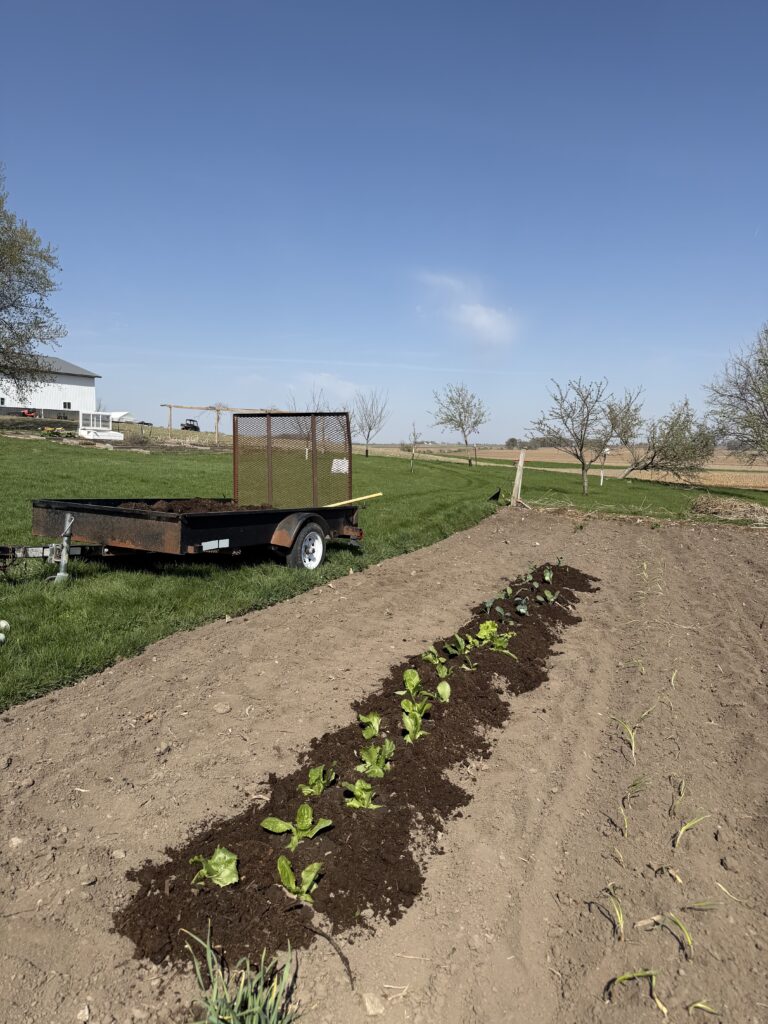
8 head lettuce, (Ithica) heat tolerant variety
8 head lettuce (Butter Crunch)
4 cabbage (Stone Head) short season for early eating
4 broccoli (Emerald Crown)
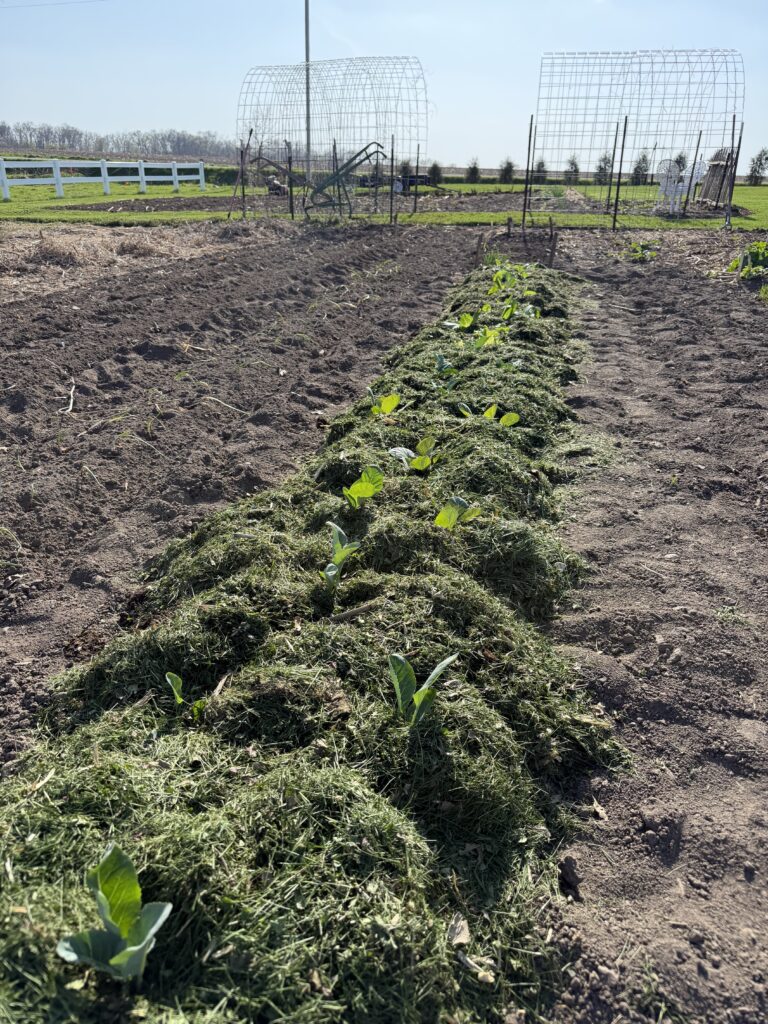
I added compost from our cow manure compost pile around all the seedlings and then topped with grass clippings as a weed barrier.
I also covered the red raspberry bed with a thick layer of compost.
The red potatoes (red Norland) that I planted on April 1st have finally sprouted. I am anxious to see how many of them will sprout and how many of them have rotted.
Notes:
To maintain a healthy microbiome, soil needs to be covered. As we near summer, temperatures rise, and the heat of the sun can bake the top layer of soil and greatly hinder the soil microbiome. As I look at the grass and Creeping Charlie trying to creep in from the edge of the garden, the tiny sprouts of weeds peeping through in other areas of the garden, I am amazed at how the earth insists on being covered.
As the gardener, how can I cover 8,000 square feet of soil before weeds take over and consume the nutrients intended for the crops that will nourish my family?
Most of the early crops will get a layer of compost for nitrogen, soil amending, and for boosting the soil microbiome. On top of the compost, we will add a thick layer of grass clippings that we have collected from our untreated yard. The thick layer of grass clippings will act as a weed barrier, keeping any weed seeds from receiving enough light for sprouting. In addition, covering the soil helps maintain a consistent moisture level and protects the soil microbiome. Other crops like sweet corn, squash and sweet potatoes will create a shade canopy and cover the earth their own way.
Reflections
As my toes sank into the freshly tilled soil of the garden my mind started wandering to the gardens of my childhood. My family would till the soil of our Pennsylvania garden each spring before planting. I have vivid memories of playing in freshly tilled soil with my siblings while Mom and Dad sowed long rows of corn, peas and potatoes. Fast forward to my adult life, my own garden, and social media. When I shared my joy in freshly tilled soil online, ‘gardening experts’ from all over the USA shamed me for tilling my soil, telling me that I was ruining my soil. I was adequately confused. If tilling ruined soil, how had my family, and now I, been successfully raising thousands of pounds of fruits and veggies for many decades? This is a great example of the saying “the proof is in the pudding,’ or in this case, “the proof is in the jars and freezers.” While this online shaming did inspire me to learn more about soil health, and soil microbiome, I also learned how much soil can differ from one region to another. And because of what I learned about soil health, I no longer till as frequently throughout the year to manage weeds as I used to. I now prefer tilling once in the spring before planting and then covering the soil as thoroughly as possible with organic matter to add nutrients and microbes and create a weed barrier. I do, however, still consider my rototiller to be one of my most essential gardening tools, despite what ‘gardening experts’ on the internet try to shame me into.
Just as soil must be covered for its microbiome to flourish, my heart’s spiritual soil also needs protection, particularly through prayer. If I try to nurture a strong spiritual microbiome in my heart without the protection of prayer, I become vulnerable, and the gifts meant to grow there may fail to take root and flourish.
So beautiful Ruth! I work in my garden and pray in it. Don’t let people shame you. God has blessed you with wisdom and knowledge. . .that’s all you need!
I look forward to these each week. I love learning from your gardening experience and hearing your heart for Jesus He gifted you to put into words.
I copied and pasted the blueberry info to print for my gardening binder for easy access when we finally get to plant blueberries. So helpful to know to incorporate peat into our heavy clay soil, add sulphur chips, and to cover them in the winter.
So grateful you can use “the experts” advice as a motivator to learn and make any needed adjustments but are strong enough to stand on your own, think for yourself, and share it with us. We till our Ky garden also. And have for 4 generations with great success. We value our tiller and desperately need a bagger on our mower.
Thank you for the gift of your time to share this info and your heart here. Already looking forward to next week and following along day to day on Instagram.
I wanted to tell you how much I appreciate your sharing the application of gardening to spiritual life. I am sharing what you wrote with my Bible study group.
Hi Ruthann, I enjoy your writing, toes in the soil reminded me of my days in Iowa. How I miss the land we owned, the garden we grew every year and the valuable lessons I learned while living there. I took a class in horticulture and one of the 1st things they said was don’t till up the soil. Lol
I live in the desert of Arizona with heavy clay, there is no growing here without tilling! I’v learned so much over the years and one of them is the “experts” do not always know what’s best. I enjoy watching the homesteading YouTubers but living here with 5% humidity and hot heat it’s next to impossible to get really good crops like what we had in Iowa. We need a desert grower for people like me. I keep trying, growing peppers in sunken holes for the water to go around the roots and lots of straw. I look forward to seeing you at the Idaho homesteaders conference, perhaps even saying hello.
I love reading your posts & watching you on YouTube! You are wise beyond your years. I have your book & love it too. I’m 75 & past having a garden ( I forage my daughter’s) but I do enjoy you & watching the kids grow up. God bless you. ❤️
This last paragraph is powerful and is what I have been feeling for my own spirit lately. I enjoyed the whole blog and the tilling confession and defense! Do what works! I just read the book Grow Good Soil and it was so good. She promotes the no-till method and gives the scientific understanding of how it affects the soils microbiome in a fun and concise way. But I also listened to a webinar with a lady who grew things commercially for cash crops for years and said that the no-till method is fine if you want to bring all new soil into a place essentially (building it on top of your poor soil slowly but that’s not so practical for thousands of acres and it’s not always attainable.
I think you are right to value your rototiller. When “breaking ground” to establish a garden with the intent of amending to soil as you do is important in a brand new garden. Soil health is what makes healthy plants. Having lots of worms like you do is doing the job of aerating the soil, leaving castings as fertilizer. Some “garden experts” feel that tilling the soil throughout the season interrupts what the worms and other beneficial microbes are trying to do. It’s like a whole other world of living organisms under the soil. I get that and agree with their thinking. Tilling the soil in the beginning of starting a garden, especially if it has never been worked is appropriate. God does that in our hearts to break up the hardness of our hearts so He can amend them with His statues and precepts. I liken fertilizer to trials in our lives. It stinks but oh does it enrich our lives over time. Look up Joe Lamp’l on youtube. He is a master at “living soil.”
Good read. I’m in Idaho, and haven’t planted my blueberries yet do to the crazy weather this year, late frost. I’m wanting to plant them in the ground. But I’m worried of killing them. Thank you for the advice on soil and the grass clippings. Wish 🤞 me luck!
Hi 👋 I have planted only a few things. I live in Conroe Texas. I think it’s zone 9. I wanted you to know that I appreciate all the tips and tricks, and cooking advice etc…
Their is no end to the evil that is happening in our country today.
I pray for peace and health and healing for all. I’m just starting on a small garden Tomatoes, cucumbers, spinach and okra. It is already in the 80° here and climbing. I hope to get some onion sets.
Have a blessed day RuthAnn 🙏
RuthAnn, I’m saddened by the cruelty of so-called do gooders on the internet. I love your willingness to faithfully share your heart, your family, and the ways of the Mennonites. You have a vast amount of information and a special way of instructing, that you through our loving Savior JESUS Christ, completely inspire me.
My mom didn’t teach me much about hardly anything, because she never really wanted, nor enjoyed being a mother; all she really wanted was her career as a nurse. I did learn from her how not to be squeamish when people and our pets got injured, and how to do alot of immediate first aid before calling for an ambulance.
So RuthAnn , you stay true to yourself, continue drawing closer to our Heavenly Father, for in Him we have our being, our true inner peace and the ability to forgive the cruelty of others. GOD BLESS YOU MY LOVING SISTER IN CHRIST JESUS.
Amen! I live about one hour north of you. Zone 4b. I also till in spring. I mulch with grass and we have plentiful maple trees, so I use leaf mulch. I have one garden which I consider no till and it works fine. But my main garden where I rotate crops such as potatoes, I till.
I admire you bc you take what is meant to shame you and turn it into an avenue to help you learn and grow. Also, you seek the Master Gardner bc He is the ultimate Source of the produce of your heart and your garden.
I would SO love to invite you for a cup of coffee!
Tilling is not always a bad thing because you replace the things that tilling disrupts. By adding compost each year and manure, you are replacing the first part of the soil. There are a lot of “if, ands, or buts) with soil. Like you said, the pH really makes a difference. My Daddy used to be a farmer, and he never knew anything about pH results, but he was an excellent farmer. You farm like your elders. I love watching your videos. I remember walking barefoot all the time when I was young. I just could not eat my chickens, but that is me. I get too attached. Take care!
I agree with you also about the haters and tilling. We all do what is best in our region. I’m proud that you do what you feel is right and not what the “internet” thinks you should do. I also till my garden in the spring after it sits all winter. Here in Buffalo that can be a long time. My soil get compacted from all the snow and rain we get, so tilling looses up that soil so I can amend and then eventually plant. God Bless you Ruth. You are such an inspiration to me.
Ruthann, I’m so sorry you were shamed! It’s easy to do even when well-intentioned! I myself have been learning & experimenting with no-till for my tiny 30×14 ft garden. I’d do no-till deep cover with straw, but not deep enough (to save money) and so weeds grew some anyway. After a couple of years, Hubby would convince me to till again, and this cycle happened several times.
After watching Charles Dowding’s No-Dig YouTube, and showing my husband, he said, if I can get my gardens that beautiful, I can do no-till. The problem is always being able to produce enough compost (without animals for manure) to cover all the beds.
Now that I have chickens, I’m able to produce much more compost each year!
Anyway, I don’t want to shame you for the system that works for you, but I would encourage you to look into the no-dig when you get the chance. I just finished reading Gabe Browns book “Dirt to Soil” and it was very educational about how everything works together. It’s his personal story of how as a farmer, unfortunate circumstances taught him to eventually go no-dig as a commercial farmer.
I appreciate you and your goals. Especially how you put relationships as more important than earthly things. That seems like the right, godly perspective. God bless you!





17 Responses
So beautiful Ruth! I work in my garden and pray in it. Don’t let people shame you. God has blessed you with wisdom and knowledge. . .that’s all you need!
I look forward to these each week. I love learning from your gardening experience and hearing your heart for Jesus He gifted you to put into words.
I copied and pasted the blueberry info to print for my gardening binder for easy access when we finally get to plant blueberries. So helpful to know to incorporate peat into our heavy clay soil, add sulphur chips, and to cover them in the winter.
So grateful you can use “the experts” advice as a motivator to learn and make any needed adjustments but are strong enough to stand on your own, think for yourself, and share it with us. We till our Ky garden also. And have for 4 generations with great success. We value our tiller and desperately need a bagger on our mower.
Thank you for the gift of your time to share this info and your heart here. Already looking forward to next week and following along day to day on Instagram.
I wanted to tell you how much I appreciate your sharing the application of gardening to spiritual life. I am sharing what you wrote with my Bible study group.
Hi Ruthann, I enjoy your writing, toes in the soil reminded me of my days in Iowa. How I miss the land we owned, the garden we grew every year and the valuable lessons I learned while living there. I took a class in horticulture and one of the 1st things they said was don’t till up the soil. Lol
I live in the desert of Arizona with heavy clay, there is no growing here without tilling! I’v learned so much over the years and one of them is the “experts” do not always know what’s best. I enjoy watching the homesteading YouTubers but living here with 5% humidity and hot heat it’s next to impossible to get really good crops like what we had in Iowa. We need a desert grower for people like me. I keep trying, growing peppers in sunken holes for the water to go around the roots and lots of straw. I look forward to seeing you at the Idaho homesteaders conference, perhaps even saying hello.
I love reading your posts & watching you on YouTube! You are wise beyond your years. I have your book & love it too. I’m 75 & past having a garden ( I forage my daughter’s) but I do enjoy you & watching the kids grow up. God bless you. ❤️
Thank you Ruthann.
This last paragraph is powerful and is what I have been feeling for my own spirit lately. I enjoyed the whole blog and the tilling confession and defense! Do what works! I just read the book Grow Good Soil and it was so good. She promotes the no-till method and gives the scientific understanding of how it affects the soils microbiome in a fun and concise way. But I also listened to a webinar with a lady who grew things commercially for cash crops for years and said that the no-till method is fine if you want to bring all new soil into a place essentially (building it on top of your poor soil slowly but that’s not so practical for thousands of acres and it’s not always attainable.
I think you are right to value your rototiller. When “breaking ground” to establish a garden with the intent of amending to soil as you do is important in a brand new garden. Soil health is what makes healthy plants. Having lots of worms like you do is doing the job of aerating the soil, leaving castings as fertilizer. Some “garden experts” feel that tilling the soil throughout the season interrupts what the worms and other beneficial microbes are trying to do. It’s like a whole other world of living organisms under the soil. I get that and agree with their thinking. Tilling the soil in the beginning of starting a garden, especially if it has never been worked is appropriate. God does that in our hearts to break up the hardness of our hearts so He can amend them with His statues and precepts. I liken fertilizer to trials in our lives. It stinks but oh does it enrich our lives over time. Look up Joe Lamp’l on youtube. He is a master at “living soil.”
Good read. I’m in Idaho, and haven’t planted my blueberries yet do to the crazy weather this year, late frost. I’m wanting to plant them in the ground. But I’m worried of killing them. Thank you for the advice on soil and the grass clippings. Wish 🤞 me luck!
Hi 👋 I have planted only a few things. I live in Conroe Texas. I think it’s zone 9. I wanted you to know that I appreciate all the tips and tricks, and cooking advice etc…
Their is no end to the evil that is happening in our country today.
I pray for peace and health and healing for all. I’m just starting on a small garden Tomatoes, cucumbers, spinach and okra. It is already in the 80° here and climbing. I hope to get some onion sets.
Have a blessed day RuthAnn 🙏
RuthAnn, I’m saddened by the cruelty of so-called do gooders on the internet. I love your willingness to faithfully share your heart, your family, and the ways of the Mennonites. You have a vast amount of information and a special way of instructing, that you through our loving Savior JESUS Christ, completely inspire me.
My mom didn’t teach me much about hardly anything, because she never really wanted, nor enjoyed being a mother; all she really wanted was her career as a nurse. I did learn from her how not to be squeamish when people and our pets got injured, and how to do alot of immediate first aid before calling for an ambulance.
So RuthAnn , you stay true to yourself, continue drawing closer to our Heavenly Father, for in Him we have our being, our true inner peace and the ability to forgive the cruelty of others. GOD BLESS YOU MY LOVING SISTER IN CHRIST JESUS.
Amen! I live about one hour north of you. Zone 4b. I also till in spring. I mulch with grass and we have plentiful maple trees, so I use leaf mulch. I have one garden which I consider no till and it works fine. But my main garden where I rotate crops such as potatoes, I till.
I admire you bc you take what is meant to shame you and turn it into an avenue to help you learn and grow. Also, you seek the Master Gardner bc He is the ultimate Source of the produce of your heart and your garden.
I would SO love to invite you for a cup of coffee!
Tilling is not always a bad thing because you replace the things that tilling disrupts. By adding compost each year and manure, you are replacing the first part of the soil. There are a lot of “if, ands, or buts) with soil. Like you said, the pH really makes a difference. My Daddy used to be a farmer, and he never knew anything about pH results, but he was an excellent farmer. You farm like your elders. I love watching your videos. I remember walking barefoot all the time when I was young. I just could not eat my chickens, but that is me. I get too attached. Take care!
I agree with you also about the haters and tilling. We all do what is best in our region. I’m proud that you do what you feel is right and not what the “internet” thinks you should do. I also till my garden in the spring after it sits all winter. Here in Buffalo that can be a long time. My soil get compacted from all the snow and rain we get, so tilling looses up that soil so I can amend and then eventually plant. God Bless you Ruth. You are such an inspiration to me.
Ruthann, I’m so sorry you were shamed! It’s easy to do even when well-intentioned! I myself have been learning & experimenting with no-till for my tiny 30×14 ft garden. I’d do no-till deep cover with straw, but not deep enough (to save money) and so weeds grew some anyway. After a couple of years, Hubby would convince me to till again, and this cycle happened several times.
After watching Charles Dowding’s No-Dig YouTube, and showing my husband, he said, if I can get my gardens that beautiful, I can do no-till. The problem is always being able to produce enough compost (without animals for manure) to cover all the beds.
Now that I have chickens, I’m able to produce much more compost each year!
Anyway, I don’t want to shame you for the system that works for you, but I would encourage you to look into the no-dig when you get the chance. I just finished reading Gabe Browns book “Dirt to Soil” and it was very educational about how everything works together. It’s his personal story of how as a farmer, unfortunate circumstances taught him to eventually go no-dig as a commercial farmer.
I appreciate you and your goals. Especially how you put relationships as more important than earthly things. That seems like the right, godly perspective. God bless you!
Beautifully said about the spirit, micro biome, and health.
I am grateful to have found your web page.
Blessings for a gentle day.
Mama t