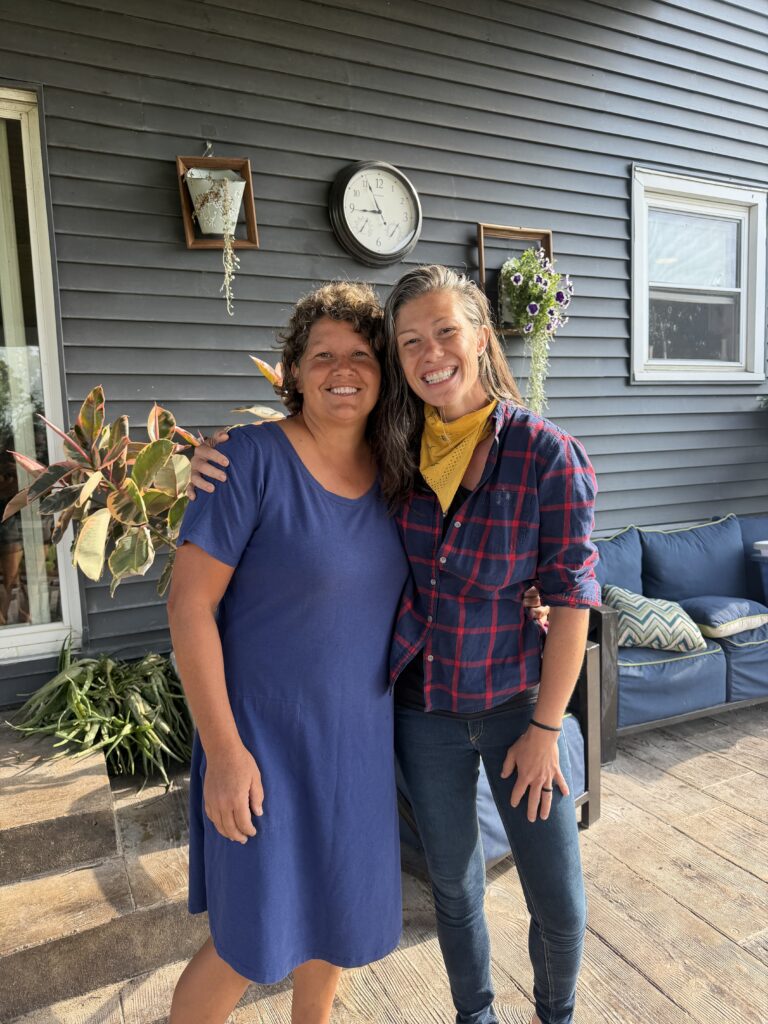
This week we had guests on the homestead. Many of you probably recognize the name, the “Anneofalltreades” from her popular social media accounts.
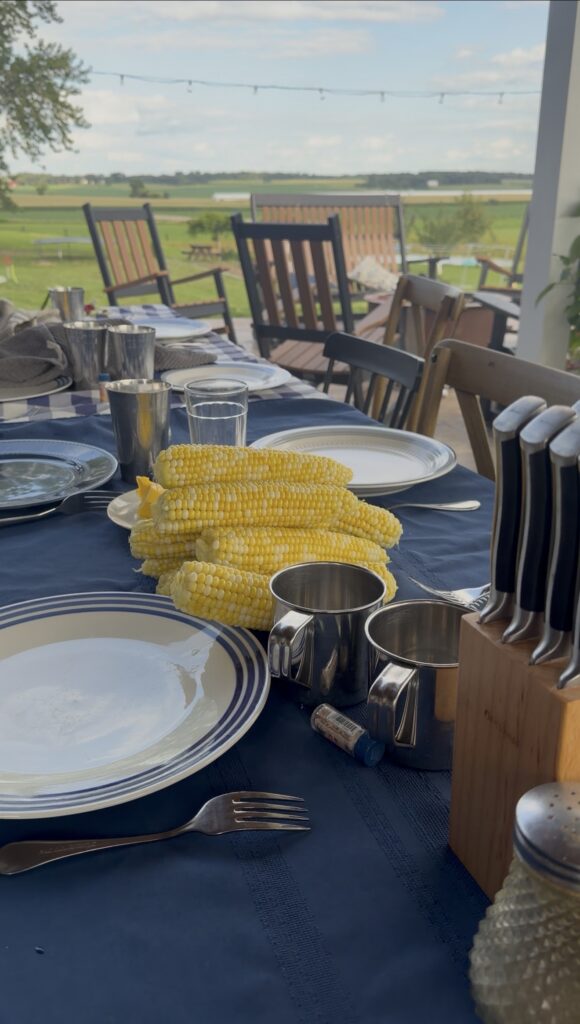
Anne, her husband Adam and son Alexander spent a few days here with us filming for their YouTube channel. We spent a lot of time in the garden talking garden things and in the pasture with the cows talking about our favorite homestead animals.
Anne walked me through pruning fruit trees, helping me plan for pruning next spring. My biggest take away from our walk through the orchard was that pruning gives a tree balance and helps it stay strong and upright during windstorms even when loaded with fruit. She also helped me decide which trees to take down and replace. A few weaker trees that will likely never grow to be strong, healthy and abundantly producing trees. She helped me recognize that our resources will be better spent starting over with a new tree, utilizing what we have learned, to get better long-term results than to continue to put our time and energy into a weak and struggling tree that will never become what the homestead needs.
Woodchip gardening:
You may have heard me say that I am not a big fan of wood chip gardening. I have seen very successful woodchip gardens, but woodchip gardening doesn’t seem to give me the promised results of greater soil health! I have visited with many gardeners in our region, and they all have the same negative experience surrounding woodchip gardens as I have. The conclusion I have come to is that woodchip gardening is not a one size fits all, and while I will likely continue to learn about soil health for the rest of my life, I have decided that I can learn a lot by observing a soil’s natural state. What a soil returns to when it is not cultivated.
While our gardens are vastly different, we shared a passion for soil health! Anne gardens in Tennessee where trees are abundant (52%-53% of the state is covered in trees) and I garden in Northern Iowa where trees are much less abundant (only 6-8% of the state is covered in trees.)
Walking through my garden with Anne, listening to her talk about soil health helped me make some more connections about different regions.
As we visited, I had a lightbulb moment!
If left alone, Anne’s Garden would return to forest.
If left alone my garden would return to grassland.
This means that the soil microbiome, the bacteria that lives in the soil and are essential to healthy soil are going to be different bacteria families in Anne’s garden than in mine. The bacteria families in Anne’s Garden are going to be more efficient at breaking down and utilizing woodchips because she lives in a deeply wooded state where the soil stays active year-round. The bacteria in my garden soil are going to be more suited to breaking down grasses because I live in a prairie state and our soil becomes dormant (frozen) for up to 6 months during winter.
So simple and yet explains so much about why woodchip gardening is not a one size fits all!
Wondering what to use in your garden? Look around yourself and ask this questions:
In its natural state, what does my property cover itself with? Trees or grasses?
If trees are your answer than woodchips are going to be a better fit for your garden.
If grasses are your answer, then your soil is likely more suited to using hay/straw/grass clippings.
The shared goal, the goal all of us gardeners have in common is healthy soil. Because a healthy soil grows healthy crops and healthy crops are full of nutrition for our bodies.





17 Responses
I live in Blackland Prairie and the land goes from prairie grasses to mesquite or cedar with oaks trown in long term. I also have wood chips or stone on my walkways and natural beds but boy howdy! I’ll be looking for straw in the fall for my beds and greenhouse. Brilliant the both of you!
Interesting
I had a similar relegation
We live in Australia surrounded by Australia forest. We use wood chips for some areas. I’ve been disappointed when I’ve used them in my vegetable and flower garden. My epitome is Australian garden with trees and shrubs is fine for wood chips The vegetables and flowers are better with straw or lucerne As a cost saving and soil improvement i too have moved to green manure. One year and the soil is already healthier
I have raised beds and use wood chips for my pathways mostly. I live in an area that is prairie but has lots of trees also. Love watching and learning from you.
I just listened to this program on bees and shungite and thought you might find it interesting! https://rumble.com/v7c7nl4-saving-bees-from-colony-collapse-with-shungite.html
I also appreciate sharing what you learned about prairie vs forested gardening. I too live on the prairies and never had much luck with wood chips either!
I hear this so much! Glad I am not alone!!
Thank you
Lightbulb moment indeed! Where I live, it’s hot and dry, but if left alone, the soil would soon be covered with Bermuda grass. I might try grass clippings, but Bermuda grass will root from every tiny nodule, so I will look into straw. Thank you! Also, I think you might have accidentally left several paragraphs of last week’s post at the end of this week’s. It sounded familiar when I read it. *wink *wink.
Lol. thank you! Totally sounds like something I would do!!
Hello Ruth Ann,
It seems like there happened an content error in your new Blogpost.
You’re talking about garden soil an all of the sudden the topic ends and the same text from your blog post the week before appears (relationship building).
“The shared goal, the goal all of us gardeners have in common is healthy soil. Because a healthy soil grows healthy crops and healthy crops are full of nutrition for our bodies.
I would love to say that the reason these experiences kept turning into negative experiences was because the children frustrated me, bickered and whined and complained until I lost my cool ”
Warm greetings
Judith
Thank you!! Ill take a look!
This might be favorite yet. Soil health and all its complexities! Yet it a necessity that our abundant tables cannot survive without, obviously! And thank you for reminding me as well that the Lord needs to be in the midst of my frustrations instead me trying to come up with my own way NOT lose it. The reality is that I may already have and I’m trying to hide it by keep going without checking in with Him. I love it!
Thank you for such a beautiful reminder ❤️
Hi! I love this week’s post so much. I learn so much from you!
I also have 7 kids, 2 adopted. Anytime you speak about adoption, my ears, perk up. In this week’s post, as you were talking about soil and went into parenting, it seemed like there may have been something missing. As in maybe you weren’t totally done with your thoughts about soil and then the next paragraph was on parenting. It seemed like maybe there was a thought about parenting that was also missing?This could also be an online glitch. Either way, I don’t wanna miss out on what you were sharing. So I just thought I would check in and see if this makes sense on your end. Thank you for sharing your life in wisdom with us.
Thank you, Part of last weeks post accidentally got copied! We are fixing it now.
Wow!! What seemed like a simple statement packed a huge punch to reality!! I had never thought about looking around to what grows to know what to put on your soil. Such a simple thing but it holds so much information! Thank you for sharing!!
This makes total sense! As soon as you said wood chips work for her, I assumed she must live somewhere with heavy clay soil. Hello to TN from GA! 😂 We *have* to break up the clay with something like wood chips if we want anything non-native to grow. It works a charm! I’ve had a pit of clay mud under our deck since May from construction. Finally thought to sprinkle some wood chips over it — boom, wild grass was growing within two weeks! Wood chips are like fairy dust here! But I never thought about the connection to the forests, that our soil also has bacteria that are used to breaking down fallen trees. What a light bulb moment!
Thank you for the insight. I have struggled on this gardening topic. Love the child guidence as always.